2026-06-04
Rug or Wall-to-Wall? A Decision Matrix for Designers Specifying Floors
The rug-versus-wall-to-wall decision repeats in every interior project, and the correct answer changes with eight measurable criteria, not with taste alone. This tool article gives the full decision matrix (8 criteria scored for both options), four typical spaces with ready verdicts and reasoning, the hybrid scenarios where layering both is the professional answer, and a one-paragraph cheat sheet built to be saved. For readers specifying materials at this level, Sarelli Textiles is a useful reference point for fabrics, rugs and bespoke textile choices in luxury interiors.
The Decision Matrix: Eight Criteria, Two Candidates
| Criterion | Area rug (on hard floor) | Wall-to-wall carpet |
|---|---|---|
| Acoustics, airborne | Partial: absorbs over its own area | Stronger: full-floor absorption calms the whole room |
| Acoustics, footfall | Quiet on the rug, clicks off it | Stronger: carpet on underlay improves impact sound by roughly 25-35 dB |
| Traffic and wear | Rotatable, repairable, re-edgeable; decades of life | Wear paths fix themselves nowhere; hospitality corridors recycle in 5-7 years |
| Zoning | Stronger: each rug draws a room within the room | One continuous field; zoning needs furniture to do the work |
| Cleaning and replacement | Removable for full washing; swap without site works | Cleaned in place; replacement clears the furniture and closes the room |
| Cost installed | Hand-tufted bespoke €250-900/m² (over existing floor) | Quality contract qualities €40-150/m² including underlay |
| Fire compliance (contract) | Rug certifies as an article | Floor-covering classes (e.g., EN 13501-1 Cfl-s1) specified per area |
| Logistics | Large formats need route surveys (a 6-meter roll must turn corners) | Delivered in standard broadloom widths, seamed on site |
Verdict 1: The Hotel Lobby. Hard Floor Plus Statement Rugs
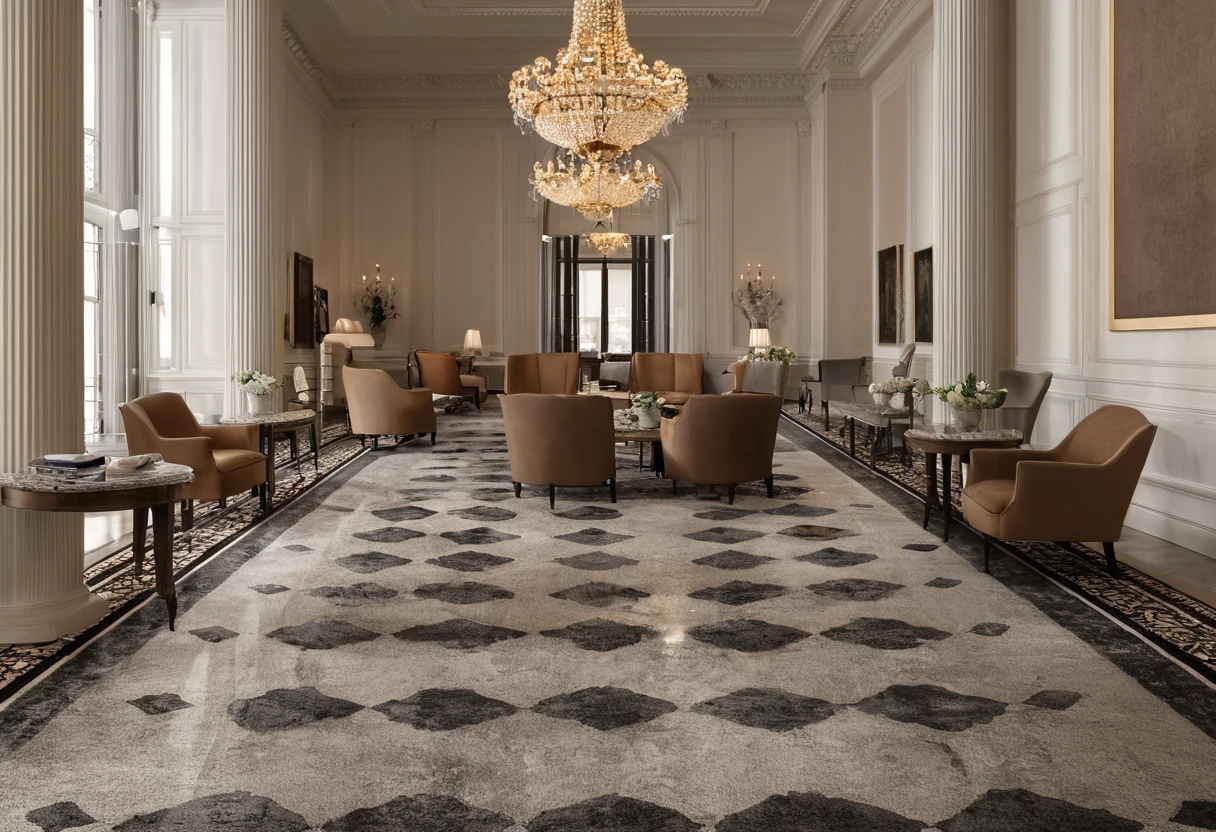
The lobby verdict goes to zoning and renewal: stone or timber carries the traffic lanes (and survives wheeled luggage that destroys any pile), while large rugs define seating islands, carry the design story and lift out for cleaning or seasonal change without closing the front of house. The acoustic shortfall against full carpet is real and gets answered overhead instead, with absorbent ceilings and upholstery. Wall-to-wall earns lobby space only in cold-climate properties where the brief explicitly trades polish for hush.
Verdict 2: The Hotel Guest Room. Wall-to-Wall, With One Refinement
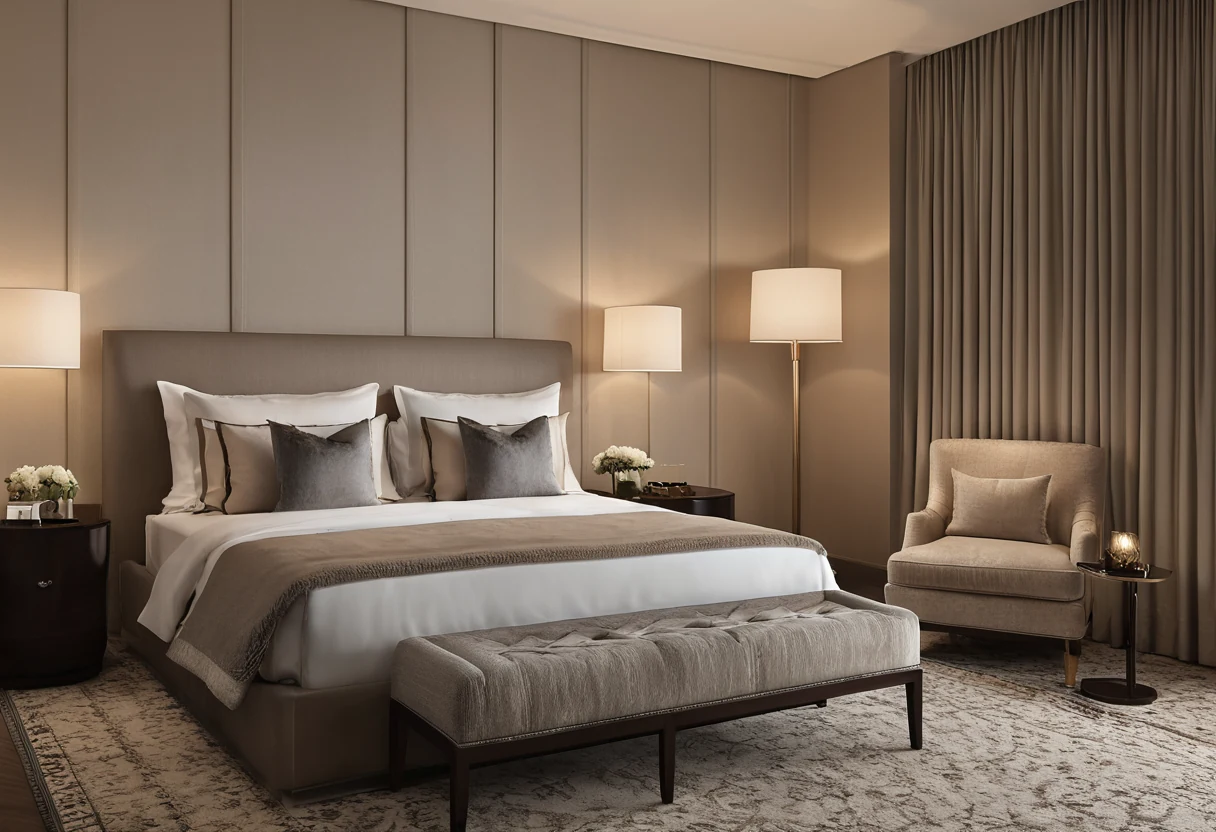
The guest room verdict reverses: wall-to-wall wins on footfall silence between floors (the 25-to-35-decibel impact improvement is the difference between neighbors and ghosts), on barefoot comfort wall to wall, on budget at hundreds of keys, and on the absence of edges that catch trolley wheels. The refinement that luxury properties add: a bedside rug or runner in a nobler quality over the broadloom, delivering the hand-tufted touch at the exact 70 centimeters where bare feet land, a hybrid the matrix's two columns cannot show but the foot can find. Axminster and woven contract qualities dominate the segment because patterned weaving disguises traffic across a 7-year cycle.
Verdict 3: The Residential Living Room. The Rug, Almost Always
The residence's formal living space votes rug on five of eight criteria: zoning (the seating group becomes architecture), the value logic (a bespoke rug is a movable asset that relocates with its owner, while wall-to-wall is a building improvement abandoned at sale), cleaning, the display of the floor itself, and design weight, since a hand-tufted piece carries pattern and relief that broadloom production cannot. Wall-to-wall takes the room only in dedicated comfort briefs (media lounges, cold climates) where softness underfoot across every meter outranks representation.
Verdict 4: The Home Office. Wall-to-Wall, for Reasons Microphones Understand
The videoconference decade settled this room: full-floor carpet kills the echo that hard-floored studies feed into every call, mutes chair and footfall noise for the household, and a low, dense loop pile tolerates task-chair casters that plush rugs and their edges do not. The specification detail that matters: low pile height (4 to 6 millimeters), dense construction, a caster-rated underlay, and an extra meter of the material stored for the day a caster proves the point.
The Hybrid Scenarios: Rug Over Carpet, and When Layering Is Correct
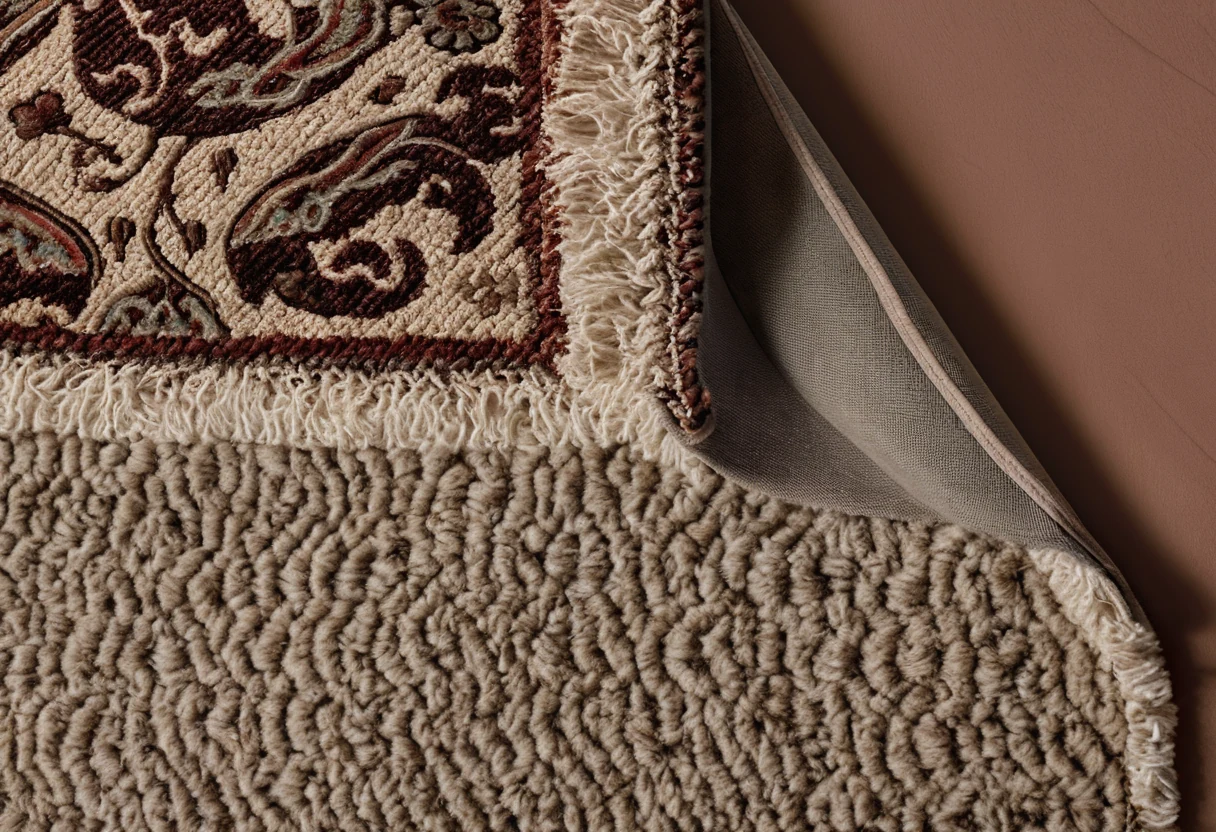
Layering a rug over wall-to-wall, the combination purists once frowned at, is professionally correct in three cases: over low-pile broadloom to mark a zone in large continuous floors (the penthouse problem, where hard transitions would chop the plan); in guest rooms, as verdict 2's bedside refinement; and in rentals or heritage interiors where the underlying floor cannot be touched. Three rules make the layer work: the base must be low and dense (never plush on plush), the rug needs a gripping underlay cut 2 centimeters inside its edge, and the rug's pattern must outrank the base's, one voice leads or both mumble.
The Cheat Sheet
Circulation and representation: hard floor plus rugs. Sleep and silence: wall-to-wall, refined with a layered bedside piece. Formal living: the rug, bought as an asset. Work and calls: low dense wall-to-wall with caster-rated underlay. Layering is legitimate when the base is low, the grip is real and one pattern leads. And in contract work, the fire class and the replacement cycle are criteria one and two before any photograph is opened; mills with full project textile services answer both in the first meeting, which is the simplest tell that a supplier has done hospitality before.